The Japanese government recommends exploring mobile battery sharing as a new option to help reduce environmental impact
In the revised Basic Policy on Promoting the Procurement of Eco-Friendly Goods and Services, established under Japan’s Green Purchasing Act by the Ministry of the Environment, the remarks section for the designated procurement category “Mobile Phones, etc. (mobile phones, PHS, smartphones)” now explicitly states that “the potential use of sharing services for portable smartphone chargers that contribute to reducing environmental impact should be considered” (*).
In response to this revision, INFORICH, which operates the mobile battery sharing service CHARGESPOT™, recognizes that mobile battery sharing is being positioned as an important policy measure from an environmental perspective. Going forward, INFORICH will further strengthen collaboration with local governments, organizations, and businesses to promote the broader adoption and utilization of mobile battery sharing services.
* Approved by Cabinet decision on February 3, 2026.
■ The Importance of Resource Circulation and Safety Management for Lithium-Ion Batteries
Mobile batteries have become indispensable to modern life. At the same time, challenges such as fires caused by improper disposal or misuse, along with the inadequate recovery of rare metals, have emerged as serious social issues. In response, mobile batteries will be subject to mandatory recycling in Japan from April 2026, following their designation as products covered under the resource recovery framework. Against this backdrop, battery sharing services, supported by established systems for management, collection, and recycling have been recognized in the recent revision of the Basic Policy as a low-environmental-impact option.
As a leading provider of mobile battery sharing services, INFORICH has focused on improving accessibility and convenience while strengthening safety management and reducing environmental impact through centralized control of batteries across their lifecycle. The encouragement to consider mobile battery sharing under the Basic Policy of the Green Purchasing Act is significant not only in advancing the formation of a circular society through reduced environmental burden, but also in helping to prevent battery-related fire incidents, which have become an increasingly serious social issue in recent years.
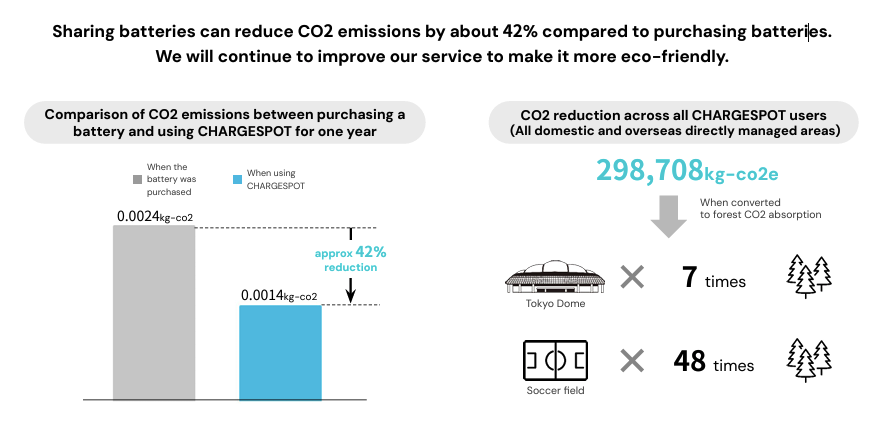
(Source: Forestry Agency)
* Calculation by Asuene Corporation.
■ Looking Ahead
Sharing schemes are effective not only in reducing CO₂ emissions by lowering the total number of mobile batteries in circulation, but also in mitigating risks such as battery fires through proper battery management, collection, and recycling.
Positioning the recent revision of the Basic Policy as an important milestone, INFORICH will continue to strengthen collaboration with government bodies, businesses, and consumers to advance initiatives that support the realization of a circular society while balancing environmental impact reduction with safety assurance. Beyond providing mobile batteries as convenient charging solutions, INFORICH is committed to operating them as social infrastructure, whilst ensuring they are used safely, collected appropriately, and circulated as valuable resources. Through these efforts, INFORICH aims to contribute to the development of a circular society by serving as a core platform connecting policy frameworks, industry stakeholders, and everyday users.
■ About the Green Purchasing Act
The Green Purchasing Act (formally titled the Act on Promoting Green Procurement by the State and Other Entities) is a Japanese law that encourages the national government and local authorities to proactively procure environmentally friendly goods and services, thereby promoting the broader adoption of low-environmental-impact choices across society.
The Basic Policy on Promoting the Procurement of Eco-Friendly Goods and Services, formulated by the Ministry of the Environment under the Green Purchasing Act, establishes principles and criteria for prioritizing products and services with lower environmental impact. In addition to product performance, the policy emphasizes systems that prevent the inefficient use of resources and the adoption of services that contribute to reducing environmental burden.
For more information : https://www.env.go.jp/policy/hozen/green/g-law/index.html